Friday, July 31, 2009

Excitement Continues to Build for ITP

Preparations continue for the Interactive Telecommunications Program that I will be starting in September, and the excitement builds with every action I take. Earlier today I was checking the course descriptions and calendar for the fall 2009 semester, which have recently become available. During this process I felt giddy like a geeky kid in a high-tech toy store. 

The focus of my activities today were on better acquainting myself with the core requirements that I will need to take in the first and second semesters. In college, these requirements are usually courses that people do not want to take but are required to because of a need to ensure that everyone receives a well-rounded education. 

At ITP the foundation courses focus on building a basic understanding regarding the applications of interactive technologies, the use of computation as a medium, and skills required for programming software and building hardware. Below are brief overviews taken from the course descriptions of the four core requirements. I can't wait to get started. 

Applications of Interactive Telecommunications Technology
This introductory class is designed to allow students to engage in a critical dialogue with leaders drawn from the artistic, non-profit and commercial sectors of the new media field, and to learn the value of collaborative projects by undertaking group presentations in response to issues raised by the guest speakers.

Introduction to Computational Media
What can computation add to human communication? Creating computer applications, instead of just using them, will give you a deeper understanding of the essential possibilities of computation. The course focuses on the fundamentals of programming the computer (variables, conditionals, iteration, functions, and objects) and then touches on some more advanced techniques such as text parsing, image processing, networking, computer vision, and serial communication.

Introduction to Physical Computing
This course expands the students' palette for physical interaction design with computational media. We look away from the limitations of the mouse, keyboard and monitor interface of today's computers, and start instead with the expressive capabilities of the human body. We consider uses of the computer for more than just information retrieval and processing, and at locations other than the home or the office.

Comm Lab
An introductory course designed to provide students with hands-on experience using various technologies including social software and web development, digital imaging, audio, video and animation. The forms and uses of new communications technologies are explored in a laboratory context of experimentation and discussion.

Monitoring, Tracking, and Behavior Changing

During the past several months there has been an upsurge in interest about the behavioral changing potential offered by new monitoring and tracking technologies.

The July issue of Wired magazine ran a cover story titled "Living by Numbers: Track your data. Analyze results. Optimize your life. " This piece focused on the emergence of monitoring and tracking technologies that have become available across a wide range of areas. Recent issues of Make and Interactions, respectively titled "Remake America" and "The Waste Manifesto", magazines also focused on possibilities created by these technologies to help us reduce waste and live in more a more sustainable manner.

These technologies enable individuals and communities to generate data regarding various types of activities and the impact of these activities, and then to leverage this data for various purposes ranging from behavioral change (e.g. tracking your runs for performance improvement, as in Nike+ ), to scientific research (e.g. making available personal data for aggregate analysis) and artistic self-expression (e.g. capturing data for lifestreaming, a la Nicholas Feltron).

These various new technologies provide us the opportunity to understand more about, and to impact, our current behavior at individual and community levels. However, the existence of these technologies is not sufficient to drive positive change. we must now design and discover compelling and effective ways to implement these technologies to help individuals and communities to achieve their goals. Articles in both Wired and Make magazines showcase examples where the sharing of data, and the development of games related to this sharing, has helped drive change for individuals and communities.

As we look for opportunities to dissect and analyze our life with these tools we need to be mindful that not everything can be parsed into measurable units for tracking and monitoring.

Life is much more than what can be grasped and measured by our rational mind. We need to remember that all the optimizing in the world is not the solution to make us happier or more fulfilled. If we reduce our experience of life and reality to metrics (in the form of numbers and words) that our mind can easily classify and optimize we will miss out on an important part of the experience of life, which is unmeasurable. At least that is my half-assed new age-y spiritual beliefs lead me to surmise.

Monday, July 27, 2009

Always Addicted to Being Always On

I am spoiled and I can't blame it on my parents. Over the past several years I have become accustomed to having constant access to my own and others' information from anywhere at anytime. More than being spoiled, I am an addict. I am part of a large and growing community of addicts from throughout the United States and other developed countries who have adopted the habit of being "always on".

Actually, we've taken this one step further. We have bought into the belief that being "always on" is an important evolutionary leap for mankind, not to mention a basic human right. I (sorry, I meant we) demand the right to have immediate access to answers for all questions, no matter how useless, and to be able to stream information about our lives, no matter how boring. I became aware of my sorry predicament during a month-long trip through Asia and Europe this summer.

I wish that this insight had surfaced through a moment of stillness and clarity. However, it was actually crystalized through the experience of several moments of techno-rage. This included multiple instances where my wife had to talk me off the proverbial edge. Actually, it was my iPhone that was on the edge of getting smashed against walls, tables, windows and other parts of various hotel rooms.

Everyone of these moments were instigated by my struggle to find and remain connected to the internet. Moments where I asked for nothing more than the ability to exercise what I believed was my inalienable human right to remain "always on." No matter how much I prayed to the techno-gods, or how many Balinese style offerings I conjured up for them, it was all to no avail.

In the end of it all, this experience helped me realize once again that being "always on" is just as bad as it is good. That is not to say that I overcame my addiction. Just like any good addict I love my addiction and have made every effort to remain "always on" since I have arrived in Brazil to visit my parents.

iPhone's Lackluster Performance as Communication Hub for World Tour

The first and longest part of our world tour is now officially finished. During this part of our trip I used a jailbroken first-generation iPhone as my personal communication hub. I chose this device because it is extremelly portable and I believed that it would enable me to capture snapshots, lo-res video, and audio snippets, it would serve as a platform for the posting of journal entries, it would support the tracking of our budget, and it would allow us to take a good amount of our favorite music and videos with us on the trip.

I knew that there were many downsides to selecting the iPhone as my communication platform. The main ones of which I was aware were limited functionality and application availability compared to a laptop or netbook, and small form factor which makes it tiring to use for development of longer form content (I guess the content I developed is more like mid-form content).

So how did the iPhone do? The results were mixed and if I had to do it over again I would definitely bring along a netbook to complement this device as a communication hub.

The shortfalls were many. First and foremost, much of the iPhone's functionality is dependent on the availability of wireless internet connections and does not support connection to online via ethernet ports. This was an issue due to the scarcity of wireless connections (both cell-based and wifi) throughout the trip. Thus, when I would write blog posts using the notes application there was no way for me to transfer this content to computers that had hardline internet connections. This was by far the biggest issue I encountered.

Other inconveniences included the lack of cut and paste functionality, problems with the video application on my phone, and issues related to storage space (which I was eventually able to overcome using the terminal application on the phone).

On the positive side, the iPhone featured applications that met most, though not all, of my requirements - the picture, blogging and financial tracking applications were usable and useful. The jailbroken phone also worked well with local GSM sim cards, enabling me to stay in touch with my friends throughout the trip.

Sunday, June 7, 2009

Testing, Testing 1 2 3

This short post is a test of the BlogPress app on my jailbroken iPhone. This is part of my continuing preparations for our World Tour. I am considering using this application to publish blog posts while travelling. Let's see how it works.


This is a test picture to determine how the photo upload functionality works.

*Mobile Post from 2009 World Tour*

Saturday, June 6, 2009

Mapping the Tour

The preparations for the world tour continue at a frantic pace. Over the past several days I've focused my attention on creating a Google map the includes all of the destinations that we've planned so far. This map features the locations and the trajectory of our trip. I've even included short description for each element on the map. You can even find contact information of our accommodations, where appropriate; when it is not personal to respect the privacy of the friends who we are visiting in Japan and Turkey.

This map will be a living tool that will be updated throughout the trip with stories about our experiences and the places that we visit in each stop of our tour. For now, it provides an interesting visual perspective regarding the trip that we have planned. This map is a way to bring this trip to life that helps us visualize and plan the trip, and share our vision and experiences with friends and families.


View Julio & Lauren's 2009 World Tour in a larger map

I have not made much progress in the next steps that I identified earlier this week. Here is a quick updates of the baby steps that have been taken:
  • I've identified the following applications for capturing and publishing video and images on the iPhone: for video I plan to use Video Recorder V3.0, which is available only for jailbroken iPhones. This application (pictured on the side) enables capture of long low-resolution 14fps videos and supports direct upload to YouTube. To capture pictures I will use the standard camera application; the Mobile Photos application will be on hand to support upload of pictures to flickr. From a sound perspective I am testing out TweetMic. This application creates tweets with links to an uploaded version of the recorded audio file.  I have not found a solution to post any of these types of media directly to our Tour blog, nor for publishing written blog posts.
  • By the end of the weekend our official World Tour travel blog will be up and running (I only half belief this claim at this point in time, but I am willing to continue being optimistic about it). Lastly, I have not yet finished developing a list of additional technology requirements such as cameras, book readers - but I think we will have little more than a second iPhone and a camera in terms of additional technological gadgets.

Thursday, June 4, 2009

Easy iPhone Ringtone Hack

I recently learned the easy and free way to create ringtones for a non-jailbroken iPhone. I know I'm behind the curve on this one but I'm sure there are others out there like me.

Each ringtone is actually just a short (30-second or less) sound file that is saved in Apple's proprietary ACC format with a "m4r" extension, as opposed to the original extension "m4a". The iPhone automatically recognizes any files in it's library with this extension as a ringtone.

So how do you prep and convert a standard music file into a ringtone? Here is a link to two sites that provide a clear outline of this process. Now you are free to rock whatever ringtone you want on your iPhone.

Using GarageBand
Here is a link to a post on the Lifehacker blog regarding how to use GarageBand (version 4.1.1 or newer) to create a ringtone from existing music files. If you have GarageBand this is definitely the better and easier way to do this.  Link: http://lifehacker.com/334073/create-custom-iphone-ringtones-the-free-and-apple-way

Using iTunes Only
Here is the alternate way to accomplish the same thing. In this scenario you don't need GarageBand - you do it all through iTunes. The one important limitation is that this will only work on unprotected music files such as mp3s. Link: http://theappleblog.com/2008/08/07/free-custom-iphone-ringtones-using-only-itunes/

Wednesday, June 3, 2009

Reading List: Interactions, March & April 2009

It has been a long time since I've posted anything regarding my readings lists (or my Interaction Design exercises for that matter). Today l'll focus on addressing the first of these deficiencies by sharing my reading list from Interactions March/April issue (I've already read the May/June issue but don't want to get ahead of myself).

Article 1: Problems before patterns: a different look at Christopher Alexander and Pattern Languages
In this piece Molly Wright Steenson examines Christopher Alexander's notion of pattern languages, and the importance of the  problem definition element of a pattern. So what the hell are pattern languages? Pattern languages are developed to help non-experts participate in the design process. Patterns are self-contained entities that describes a problem that reoccurs within a given environment. The pattern also contains the core solution that enables the people to use this same solution "a million times over, without ever doing it the same way twice." If anyone knows of other good resources on this topic please leave a comment.

Article 2: Embodied Child Computer Interaction: Why Embodiment Matters
The next interesting piece from this issue comes from Alissa Antle. In this article she explores the importance of embodiment in child computer interaction, and the cognitive role the embodiment plays in general. Alissa also investigates briefly opportunities that are afforded via embodied interactions and cognition (check out more about The concept of embodiment from my previous posts regarding Dourish' book).

Article 3 and 4: Identity theft and the challenges of caring for your virtual self and The Ambient Mirror: creating a digital self-image through pervasive technologies
These two piece are part of this issue's focus on privacy and security in our digitally connected society.

The first piece, by , adresses the security of the digital representations we create to communicate our identities in the virtual world of bits and bites. These representations encompass our profiles on ecommerce and media sites, as well as our data from social networks. One interesting area that is explored by Jennifer is how individuals are often positioned as the source of identity theft, despite the systematic prioritization of profits and self-interest on the part of organizations who hold the data.

Dimitris Grammenos's piece offers an interesting exploration regarding how pervasive computing may impact our lives, as it continues its invasion of our physical and social worlds. The world he paints is a stark contrast to the notions of Big Brother. He examines how pervasive technologies, embodied by the idea of an "ambient mirror", could augment and enhance our lives - from extending our memory to self-knowledge and improvement. He also briefly addresses social considerations of such a technology.

Article 5: Taking a broader view of the human experience
Mark Vanderbeeken provides a valuable counter-perspective to most designer's narrow focus on usability (and aesthetics) at the expense of broader human considerations such as technology, ethics, economics, culture, belief systems and sustainability. The broadening of our perspective is crucial for designers to be able to play a positive and constructive role in shaping our fast paced

Monday, June 1, 2009

Jailbreaking and Calendar Making

Technology planning for our world tour continues unabated as our departure date looms closer and closer. I'm happy to report some progress and successes have been made during the past few days with my old iPhone and the World Tour calendar.

First and foremost I was able to get my jailbroken iPhone to work on T-mobile's network. I received a PrePaid sim card that worked with little fanfare. That's right, I am no longer a captive prisoner held back by ridiculous contracts and code. This is an important development because I now know that I can use this phone with third party GSM sim cards from around the world during our world tour.

For anyone who is interested in learning more about how to jailbreak your iPhone here is the set of resources that I used. It was pretty straightforward, the heavy lifting has been done by others.

Please note that there are risks inherent in this process and I cannot vouch that it will work on your phone nor can I guarantee that it won't have negative long term impact on your device. In other words, do this at your own risk.

The most helpful resource that I discovered was the iPhone Blog. Here you can find step by step instructions on how to jailbreak your iPhone using the Pwnage tool. Make sure to read all the the instructions once over before you attempt to jailbreak your iPhone. I believe there is little risks of permanent damage. However, you may end up having to do it several times as I was forced to.

Another helpful resource is the modmyi.com's wiki Pwnage 2.x Guide page. This resource also features step by step instructions on how to jailbreak your iPhone. However, I think the instructions featured here only work if you have previously jailbroken your iPhone using Pwnage (they differ in only one way from the instructions on the iPhone Blog, which did work for me).

The second area in which I have been making some progress is on the official tour calendar. I've set this up using google calendar and it includes all locations, flights, and dates from our trip. I've also created a second calendar with logistical information for Lauren and me (e.g. hotel names, wedding even schedules, etc). The purpose of this calendar is to serve as a planning and sharing tool. Here is a link to the latest and greatest version:


Here is my next steps for this week:
  • Identify capture and publishing solutions for audio, video, images, and text on iPhone.
  • Create blog and test out the publishing solutions.
  • Develop list of additional technology requirements such as cameras, book readers.

Wednesday, May 27, 2009

Dancing and Traveling

During the past several weeks I have been devoting less time to my interaction and experience design journal for two reasons: Lauren and I have been planning an around the world the trip for this summer; and we have been rehearsing for a dance performance that we delivered at a friend's wedding this past weekend.

The good news is that these preparations are coming to an end. The not so good news is that I won't be able to get back to my curriculum because I've decided to take a detour and focus on considering what aspects of technology, culture, design, and experiences I can explore during our trip around to world.

There are two main perspectives on digital communication technologies that I want to explore: first, I want to leverage technology to capture and share my and Lauren's experiences; second, I want to investigate how different cultures relate to technology and are designing and adopting technology to support local endeavors.

From a personal perspective I am looking for a mobile/portable solution that will enable me to capture and publish experiences from this trip. This solution will include multiple hardware and software products. Here is a brief overview of the tools currently under consideration:
  • Personal communication hub: the main contender for my personal communication hub is my first generation (aka 2G) jailbroken iPhone. This device would enable me to capture quick snapshots, lo-res video, audio, and journal entries. The main downside of selecting the iPhone as my platform is that I will not be able to publish directly from the iPhone, even in a wifi area, as I have not found any acceptable blogging apps. A secondary drawback is that the 2G iPhone has lower quality audio and video capabilities (available on jailbroken phones only), and no GPS. I am not willing to take a laptop due to considerations related to portability (we'll be on a 34-day trip) and theft.
  • Additional devices: I will also definitely take a camera for higher quality photos and video. I am uncertain about whether I will be willing to invest in a new Canon G10 - the temptation is strong, it is hard to resist. We will likely take our existing camera as well, a Canon SD950.
  • Publishing tools: to publish all of the content that we capture and create I plan to use several platforms including a blog (on blogger), my existing flickr account, google calendar and maps, daytum, and youtube; I'm still considering if and how to integrate twitter and facebook without driving myself crazy.
From an observer's perspective (with no real claim of being objective) I want to explore how people from different cultures leverage familiar technologies in different ways; and what different technologies they have developed that are specific to local contexts.

For example, how are mobile phones used differently based on local cultural, and economic contexts; what different services are available, and how have they adapted other services to meet their needs; what meaning does the society ascribe to cell phones.

Over the next three weeks I will share more about the technology-related aspects of the planning for this trip. Once we are off I will also document how technology ultimately enhanced, or totally screwed up, our trip (after all I do believe that technology can be both a force of good and evil).

Friday, May 15, 2009

Statement of Purpose for ITP

I am excited for this opportunity to share with you more about what I am up to. Below I have posted the statement of purpose that I submitted with my application to the Interactive Telecommunications Program at NYU.

Writing this piece was difficult and cathartic. It required that I take a long and hard look at the reasons why I am pursuing this goal, and do a good bit of soul searching to identify which questions I want to explore in this program. This process forced me to start to crystalize what I want to create through my involvement at ITP. At the end of it all, I was more excited and energized than ever to pursue this path.

Over the next two years I will work to bring into existence many of the possibilities that I discuss in this piece. I look forward to sharing my experiences while on this journey, both the successes and failures. Not to mention that I'm sure I'll need guinea pigs from time to time. My only request in sharing this with you is that you feel free to share your own thoughts and ideas in return.

Statement of Purpose

"I’ve cultivated a passion for design and technology since I was teenager. My interest in design has inspired me to undertake numerous personal projects spanning industrial, graphic, web, and sound design, while my passion for technology has supplied valuable tools that have supported my projects and opened doors to new experiences. The increasingly pervasive role that technology plays in my life has given me a deeper understanding of the ways in which people engage with technology. As users of technology, we constantly shift between acting “through” it, as a tool, and acting “on” it, as an object of engagement itself.

I have become fascinated with the possibility of combining these passions in a new configuration: acting “through” design in order to act “on” technology. It is evident to me that the Interactive Telecommunications Program at New York University is the right place for me to explore this convergence of design and technology.

My interest in harnessing the power of design to enhance technology is not for technology’s own sake. It is driven by a belief that technology can have positive and negative consequences. Designers have an important role to play in shaping the evolution of technology by appropriately designing our interactions with, and through, technology.

On a personal level, I am inspired by the power of technology to enable connections between people, and to communicate meaning in engaging new ways. My iPhone has revolutionized the way I stay connected to people, content and places, and has also altered my expectations regarding their accessibility. The Nintendo Wii, by designing interactions that mimic the familiar gestures we use to do things in the physical world, enabled me to connect with friends who had no previous interest in video games.

The power of technology is ever more defined by its ability to connect people to other people, communities, and organizations. As a marketing communications professional I have realized that people have become empowered by technology to challenge the control once held by corporations over distribution of information. Traditional marketing communications now compete with the voices of millions of individuals, who on an aggregate level have a higher degree of credibility. At the same time, the connective power of technology has enabled the fragmentation of society into distinct communities that subscribe to different beliefs and value systems.

These are some of the realizations that have sparked my desire to experiment with design of technology-based interactions and experiences. My pursuit of this goal is driven by passion, curiosity, discipline, and integrity.

I designed a three-year plan and curriculum to channel my passion and curiosity in a disciplined manner. The first phase, currently in progress, is focused on building a theoretical foundation of knowledge through consumption and production of content that supports the development of an analytical design-perspective. The second phase concentrates on development of design production skills using a project-based approach that provides opportunities for learning through practice. The curriculum will then culminate with a focus on creativity driven by an integration of my analytical and production skills through continuous theoretical and hands-on engagement.

I have used similar strategies to achieve other important personal goals. When I moved to New York City in January of 1999, I created a similar plan to pursue DJing. After three years I was transformed from having no knowledge of how to spin records to moonlighting as a DJ with bi-weekly residences at popular parties in downtown lounges and clubs.

These pursuits have other important features in common: a genuine desire to share something of great personal value, and a focus on integrity. Sharing the joy and energy that music brought to my life was key to my success as a DJ. Acting with integrity also contributed to my accomplishments, though until recently I failed to notice that my actions did not support this same goal at a community level. I’ve realized that acting with integrity includes not only standing by my own promises. It also requires holding others accountable for their commitments. I failed to notice that I had too often sacrificed my authenticity and honesty because I was afraid of hurting someone’s feelings or not being liked.

This failure undermined my ability to grow as a leader and to contribute to the growth of other individuals within my personal and professional communities. Now, while I still place emphasis on getting along with others, I am also conscious that my integrity depends on direct and honest communications.

My interest in human growth and development is one of my main inspirations for applying to ITP. Beyond investigating how to improve interfaces with machines, I want to explore how technology can enhance the way human beings experience the world. How can technology create constructive new ways for people to communicate? How can we guide its continued expansion into our physical and social worlds so that it has a positive impact on the way we conceive and communicate our identity and individuality? How can it help to transform our consciousness so we depend less on a conditioned response and become more actively engaged?

I also want to explore how technology can be made accessible to a greater number of people. How can we create new and more natural and delightful ways for human beings to interact with computational devices? How can we enable communities of people who have special needs such as illiteracy or disability to interact with computational devices?

I know that the Interactive Telecommunications Program at NYU would provide me with unrivaled opportunities to investigate these areas of interest. I am attracted by the program’s focus on hands-on experimentation and the self-directed project-based framework on which it is built. I have limited experience writing code and building physical computing devices, but I have passion and desire to learn, which is evidenced by the assortment of cell phones and computers I’ve collected for hacking.

I have already started down the path of interaction design, and I would consider it an honor if I could integrate studies at ITP into my journey. In return I am eager to dedicate my passion, energy, commitment, and contagious optimism to ensure the continued success of this program."

Monday, May 11, 2009

Back to School at the Interactive Telecommunications Program at NYU

I'm going back to school. I am officially enrolled in the Interactive Telecommunications Program at the Tisch School of Arts at NYU. This is an extremely exciting and valuable opportunity for me. It is an ideal compliment to my personal interaction and experience design curriculum.

This program affords me the chance to develop practical know-how regarding how to create engaging and valuable experiences using communication technologies. My existing theory-based (know-that) knowledge, accumulated from much reading and writing during the past 8 months, should come in handy.

Here is a brief overview of what the program's mission (straight from their own website): "to explore the imaginative use of communications technologies — how they might augment, improve, and bring delight and art into people’s lives. Perhaps the best way to describe us is as a Center for the Recently Possible."

This event has several implications for this blog. From a content perspective, I will begin to post information related to my ITP experience. All of these entries will be tagged with the label ITP .  I will begin this series by posting my statement of purpose. Then I will share project ideas and questions I find worth exploring. I hope that this will help me refine my thoughts and ideas.

The last and most superficial impact of this event is a title change for this blog. I am currently planning to change form Learning Interaction and Experience Design to Technology/Culture/Design/Experience. This is officially the "acting" tile; which means that any day now it can be replaced by the actual title (if organizations can do this with their employees why can't organisms do the same with our own resources, such as blog titles).

That's all for tonight, I am suffering from a mild mental blockage (it took me over an hour to write this short post). I will have much more to say about ITP over the coming months.

Thursday, May 7, 2009

ID FMP: Unified Theory of Design

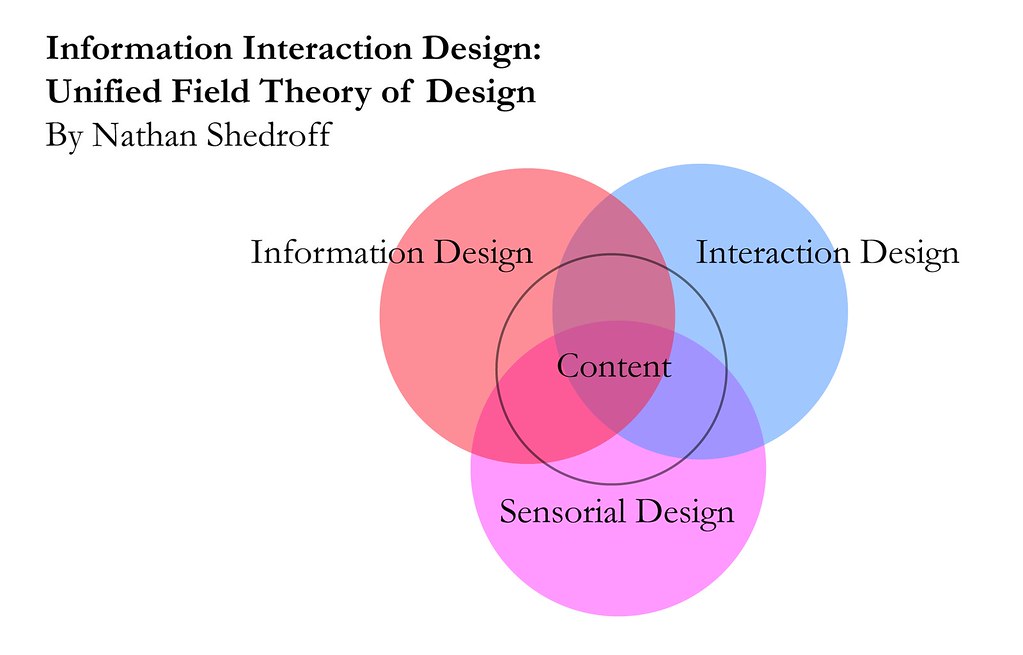
Nathan Shedroff offers a valuable unified theory of design that brings together information, interaction, and sensorial design. This theory is based on the premise that leveraging existing and creating new ways to organize and present data and information is a process that is roughly the same across media.

The intent of this theory is to enable people to create “valuable, compelling, and empowering information and experiences for others.” (Shedroff believes that these design skill are crucial for success in modern society.) In order to create these experiences people need to have a message and a reason for communicating it

The relationship between information, interaction and sensorial design disciplines is visualized as a Venn diagram. Each discipline encompasses different types of expertise. To create compelling content and engaging experiences designers need to bring to bear skills from all of these realms.

I classify this theory as an experience design framework because it brings together all disciplines required to created compelling communications and engaging experiences. Nathan has developed other valuable experience design-focused frameworks that I will explore in future posts.

First off, I’ll provide and overview of Shedroff’s definition for information, interaction, and sensorial design. Then I’ll delve deeper into each of these disciplines to explore relevant concepts and frameworks.

Overview of Information, Interaction, and Sensorial Design
  • “Information design addresses the organization and presentation of data: its transformation into valuable, meaningful information.” Information design has been practiced by graphic designers and publishers for a long time, though they rarely identified these practices as a distinct discipline. Recently this discipline has become more importance due to the proliferation of data, and the need to synthesize this data into information, knowledge, and ultimately wisdom.
  • Interaction design is “essentially story-creating and telling, [that] is both an ancient art and a new technology.” Interaction design for many traditional media such as print, TV and outdoor is limited and guided by existing conventions. Interaction design has long been practiced by industrial designers and live performers, though they did not identify it as its own discipline. The new possibilities for interaction offered by interactive technologies have increased the importance of interaction design.
  • “Sensorial design is simply the employment of all techniques with which we communicate to others through our senses.” This includes writing, visual techniques (e.g. graphic design, animations, and videography), sounds, smells, tactile feel (e.g. industrial design, and material selection). Sensorial design disciplines have their own histories, concerns and practices. The traditional focus of most design disciplines is on sensorial design. That said, most great designers had an understanding regarding information and interaction design, even if they did not recognize these practices as distinct disciplines.
Information Design
“An understanding of information design starts with the essential view that the vast amount of things that bombard our senses everyday are not pieces of information but merely data.” To transform data into information it needs to be organized, and presented in an appropriate context that can give it meaning. Information can be consumed via experiences that generate knowledge. Experiences can then eventually generate wisdom.

The Continuum of Understanding
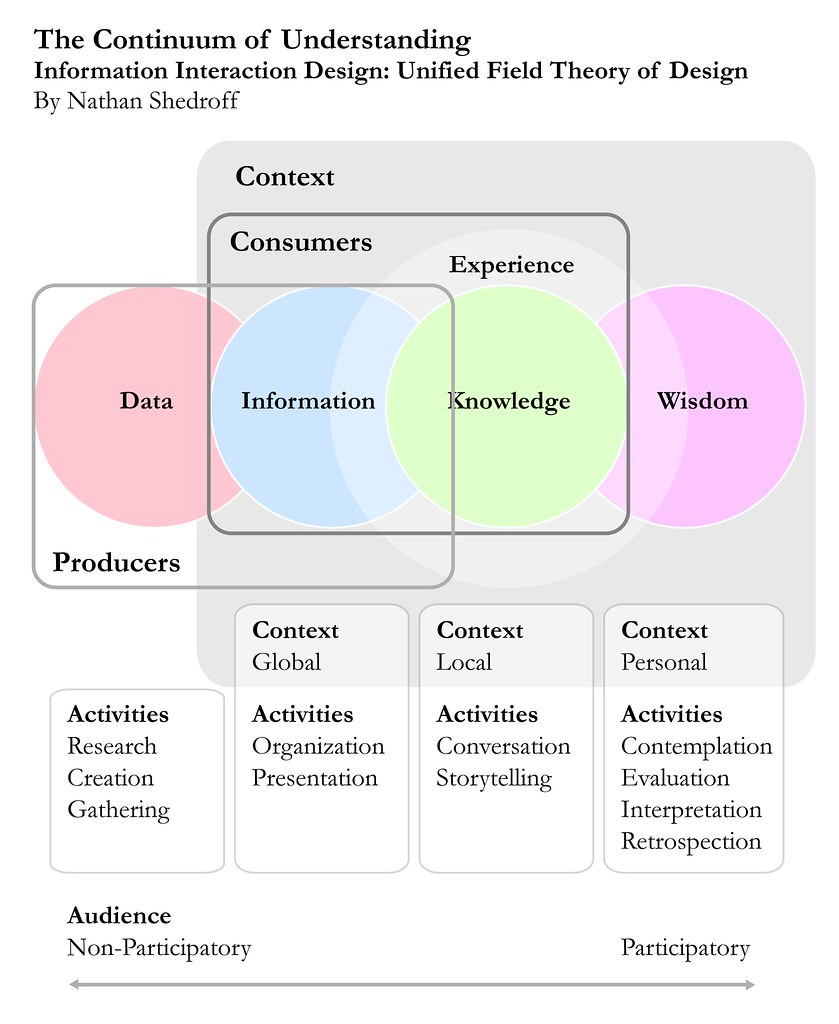
Data and information are both part of a continuum of understanding. This continuum maps the relationship between four different levels of understanding: data, information, knowledge, and wisdom.


Data represents the lowest level of understanding along this continuum. It is the “raw material we find or create” to build our communications. By itself data does not contain a complete message and is inconsequential and boring. For these reasons data is mostly useful to people who produce content.

Data is transformed into information when it is organized and presented in a context that makes relationships and patterns visible and delivers meaning. Producers of information determine what data is used guided by their own goals and conceptual models. On the other hand, consumers determine how the information is consumed and evaluated according to their own goals and mental models.

The next ladder up on the continuum is knowledge. Knowledge refers to the understanding that we gain through experience. It is created by the integration of information with our existing mental models and understandings. Knowledge is participatory level of communication that can be individual or shared. As such, it can only be communicated through compelling interactions that enable people to identify patterns and meanings in information.

The highest, most intimate and vague level of understanding is Wisdom. Less is known about it than any other level, other than it is more abstract and philosophical. “Wisdom is a kind of ‘meta-knowledge’ of processes and relationships gained through experiences. It is the result of contemplation, evaluation, retrospection, and interpretation – all of which are particularly personal processes.” Unlike knowledge, wisdom is hard to share, and occurs at an individual level only.

Organization, Metaphors and Goals
Organization is the first step in the process of transforming data into information, so that it can be communicated effectively. This is a crucial activity because the organization of data impacts the way information is understood and interpreted by others. Shedroff identifies several common ways to organize information: Alphabets, Locations, Time, Continuums, Numbers, Categories, Randomness, Advanced Organizations, and Multiple Organizations.

Metaphors can also help transform data into information because they can enable people to quickly understand relationships and meanings. That said, when metaphors are used poorly (as they often are) they can worsen the user experience and limit the possibilities for progress associated to the design of information, interactions and senses.

Definition of objectives and messages is a crucial strategic step in the development of effective communications. All design decisions should be guided by pre-defined goals and messaging considerations.

Interaction Design
Interaction design is focused on the creation of experiences that are appropriate, effective, delightful, and even wonderful. Traditionally, the design of interactions has been practiced mostly in the performing arts such through disciplines such as script-writing, storytelling, performance, and instructional design. More recently, interaction design has become a key practice associated to the development of computer-based products and services.

Continuum of Interactivity
Nathan offers an interesting perspective on interactivity: “One way to consider the meaning of interactivity is to envision all experiences (and products) as inhabiting a continuum of interactivity.” This continuum ranges from passive experiences to interactive ones. There are six main attributes that can differentiate interactive experiences from passive ones. Interactive experiences offer the user with clear feedback, enhanced control, and additional opportunities for creativity, productivity, communication, or adaptability.


Feedback and control are closely related. All experiences with high interactivity provide high levels of feedback and a minimum level of control. Feedback enables the person interacting with a device to perceive (and hopefully understand) the impact of their actions. Control enables that same person to carry out actions on, and through, the device.

Creativity and productivity are two attributes of interactivity that are related to making, doing, and sharing things. Highly interactive experiences are better able to support creativity and productivity than passive ones. For example, guitar lessons available on the new Garage Band are more effective educational tools than those available via most books because they are more interactive.

Communication is an attribute of interactivity that is focused on enabling people to meet people, talk to others and share opinions and stories. By definition, experiences that support communication provide a high-level of feedback and control.

Adaptivity is the final attribute of interactivity explored by Shedroff. It is related to the adaptation of a system in response to changes in user behavior or context. Highly interactive experiences often provide features such as agents and additional tools and functionality based on user behavior or context. For example, video games get harder as the player gets better and progresses through different phases and reaches new milestones.

To help visualize different activities across these various attributes of interactivity, Shedroff developed an experience cube (a simplified version of a six-sided diagram that was originally attempted). This cube maps feedback and control as a single dimension, next creativity, productivity and communication are grouped as another dimension, adaptivity remains its own dimension. Any experience, whether computer mediated or not, can be mapped within this cube.

Sensorial Design
Sensorial design encompasses all disciplines related to the creation and presentation of media – graphic design, sound design, photography, animation, calligraphy, typography, cinematography, illustration, etc. This includes any design endeavor associated to the purposeful stimulation of the senses: tactile, visual, olfactory, or auditory. All of these disciplines share a few common concerns: a focus on understanding human senses; and a concern with the appropriate use of media, style, and technique.

[This information is sourced from a paper by Nathan Shedroff titled: Information Interaction Design: A Unified Field Theory of Design ]

Thursday, April 30, 2009

ID FMP: Distributed Cognition Models

Distributed cognition models conceptualize cognitive phenomena as happening across multiple individuals, objects, and internal and external representations of knowledge.  In contrast to the Information Processing Model, which is only focused on activities that happen inside the head, this model focuses on internal and external activities and encompasses External Cognitive Processes and Coordination Mechanisms described in my previous posts.

In comparison to these three frameworks, distributed cognition models provide more precise descriptions of internal and external cognitive activities. They are less abstract because their domain is limited to cognitive activities associated to specific contexts (e.g. piloting an airplane, doing taxes).

The three frameworks previously mentioned provide general descriptions of how human cognition works across all contexts. Their focus is on defining general laws that describe how our brain processes information and leverages the external world to enhance our cognitive capabilities. The distributed cognition model offers a phenomenological perspective that explores cognition as an embodied activity that takes place in specific physical and social contexts.

For example, a distributed cognition model that describes the activities that take place at an agency during creative development would differ considerably from that of a law office. They would feature many commonalities but the important thing is that the differences matter.

This perspective is important because designers need to understand how their product or service will actually fit into people’s day-to-day life. The insights that can be gleaned from the Information Processing and External Cognitive Activities Frameworks do not provide this type of understanding.  Distributed cognition models focuses on mapping these mundane day-to-day activities. They provide insight into how people actually make and share meaning and decisions within specific contexts.

A distributed cognition analysis is usually carried out as the basis for development of a distributed cognition model. Here is an overview of the main areas of examination in these types of analysis. As an example (and to work my brain just a little bit) I’ve carried out a high-level analysis of the distributed cognitive activities that take place at an advertising agency.
  • How does distributed problem solving take place? How do people work together to solve problems? In an agency environment, tasks are distributed across several departments with specific areas of expertise (e.g. client services, account & strategic planning, media, production, creative and traffic). People work together by coordinating their actions using documents (such as schedules, briefs, spec sheets and emails), events (such as meetings, phone calls, and presentations), and shared work practices (such as common vocabularies, understandings, and culture).
  • What ways does communication take place throughout the collaborative process and how is knowledge shared and accessed? Does it change as the activity progresses? Communications take place via meetings, emails and document artifacts such as presentations, briefs, schedules, conference reports, creative comps and spec sheets. The most important information is documented to facilitate sharing. Many of the document artifacts evolve as the activities progress. For example, a creative brief may be updated to reflect changes in strategy. The creative comps also change via multiple rounds of client reviews.
  • What is the role of verbal and non-verbal communication? What types of things are said or implied? Verbal communication is the primary type of communication associated to the management of projects (and communication associated to those projects). Non-verbal communication plays a fundamental important in the activities of the project itself. Layout design, videos, images, graphs, and even experiences are be used to brief creative teams regarding products or brands, and in client and internal presentations. The final creative product delivered by Agencies also employs both verbal and non-verbal communication. To elicit emotional responses from people agencies use non-verbal tools such as images, visuals, videos, sounds, interactions online, and more. In agency communication is often reinforced through by verbal and non-verbal communication.
  • What coordinating mechanisms are used? What are the rules and procedures that govern the workflow? There are several important coordination mechanisms that are used in an agency. These mechanism leverage external representations of knowledge such as schedules, job jackets, spec sheets, readers, status reports, conference reports, emails, calendars, scopes of work, etc. They also include meetings such as internal and client reviews, status meetings, and production kick-offs. Many rules and procedures are outlined in the agency’s process manual. These processes govern how work flows through the agency.
[source: Interaction Design: Beyond Human-Computer Interaction, page 129.]

** What the hell is ID FMP? **

Sunday, April 26, 2009

ID FMP: Coordination Mechanisms

Coordination is an important skill that is required to carry out activities that range from basic to complex. All collaborative activities heavily rely on the ability of individuals to coordinate their actions; all group activities require some level of coordination. Even personal activities often require coordination such as prioritization and scheduling.

So what is coordination? Coordination is the “the regulation of diverse elements into an integrated and harmonious operation” (wordnet.princeton.edu/perl/webwn). In other words, coordination refers to the phenomenon where one or more people act or interact with to accomplish a goal or complete a task. Much of the thinking related to coordination focuses on group, rather than personal, activities.

Sharp, Rogers, and Preece have identified three different types of coordination mechanisms that people use to coordinate their actions with others. I’ve modified their framework by adding one additional type of mechanism; I decided to break down their second category into two separate entities. As you will note, these coordination mechanisms are interdependent and overlapping.
  • Conventions and shared practices: Conventions and shared practices refer to the shared social and cultural understandings and beliefs that provide a foundation for coordination. Examples include cultural expectations about punctuality, shared understandings regarding meaning of activities or artifacts. These phenomena account for why it can often be harder to coordinate activities with people from different socio-cultural backgrounds. Shared conventions and practices along with verbal and non-verbal communication play a key role in enabling people to effectively use schedules, rules and shared external representations to coordinate activities.
  • Verbal and non-verbal communication: spoken and written language, and non-verbal gestures are often used as primary means of communication for the coordination of activities. Conversations are an important medium for the coordination of activities and negotiation of commitments. Written documents, such as agendas, presentations and reports, are also common tools for coordinating groups. Gestures play an especially important role in supporting the coordination of activities in situations where the conditions do not allow for users to communicate using verbal communication; examples include, a catcher using hand signs to communicate with a pitcher and a conductor using the motions of his arm and baton to lead an entire orchestra. Gestures can also help support communication between people who do not share the same language.
  • Schedules, maps and rules: Schedules, maps and rules are artifacts that document communications that outline the order of activities, conventions and shared practices. Schedules focus on organizing activities and objects across time while maps organize activities and objects across space – both are crucial tools for personal and group coordination. Rules offer descriptions of conventions, shared practices and other principles that facilitate the coordination of activities. The benefit of rules and schedules is that they enable groups of people with different practices and conventions to create a shared set of documented principles to guide their coordination and collaboration.
  • Shared external representations: Shared external representations are schedules, rules and other forms of visual or physical artifacts that are shared by a group of people. Examples vary widely across industries; in agencies like the one where I currently work, a job jacket and router is used to provide information regarding who has reviewed and commented on a given project during each round of its development. Shared online calendars, such as google calendar, offer the ability to share schedules and create shared external representations in a virtual, as opposed to physical, environment.
Activities associated to coordination are directly supported by the Cognitive Processes and External Cognitive Activities Frameworks. The mechanisms for coordination with groups encompass rely on the processes and activities outlined in these models.

Conventions and shared practices reside in the mind and are largely governed by cognitive processes such as memory, learning, and higher reasoning. While cognitive processes associated to language enable us to use verbal communication and plays an important role in our ability to create and understand external representations.

Externalizing cognitive activities is a crucial element most types of coordination mechanisms. Memory offloading is a crucial benefit provided by schedules, maps, rules, and external representations. Computational offloading is often employed using verbal communications and shared external representations. Annotating and cognitive tracing is mostly used on schedules, maps, and shared external representations.

[source: Interaction Design: Beyond Human-Computer Interaction.]

** What the hell is ID FMP? **

Wednesday, April 22, 2009

Chapter 5 Homework: What is Interaction Design

This assignment was taken from the fifth chapter of the book Interaction Design: Beyond Human-Computer Interactions, written by Helen Sharp, Jenny Preece, and Yvonne Rogers.

Assignment Questions
This assignment requires you to write a critique of the persuasive impact of a virtual agent by considering what it would take for a virtual agent to be believable, trustworthy, and convincing.

Question A: Look at a website that has a virtual assistant, e.g. Anna at Ikea or one of the case studies featured by the Digital Animations Group (DAG) at http://www.dagroupplc.com, who specialize in developing a variety of online agents, and answer the following:
  • What does the virtual agent do?
  • What type of agent is it?
  • Does it elicit an emotional response from you? If so, what kind?
  • What kind of personality does it have?
  • How is this expressed?
  • What kinds of behavior does it exhibit?
  • What are its facial expressions like?
  • What is its appearance like? Is it realistic or cartoon-like?
  • Where does it appear on the screen?
  • How does it communicate with the user (text or speech)?
  • Is the level of discourse patronizing or at right level?
  • Is the agent helpful in guiding the user towards making a purchase or finding out something?
  • Is it too pushy?
  • What gender is it? Do you think this makes sense?
  • Would you trust the agent to the extent that you would be happy to buy a product from it or follow it guidance? If not, why not?
  • What else would it take to make the agent persuasive?
Question B: Next look at an equivalent website that does not include an agent but is based on a conceptual model of browsing, e.g. Amazon.com. How does it compare with the agent-based site you have just looked at?
  • Is it easy to find information?
  • What kind of mechanism does the site use to make recommendations and guide the user in making a purchase or finding out information?
  • Is any kind of personalization used at the interface to make the user feel welcome or special?
  • Would the site be improved by having an agent? Explain your reasons either way.
Question C: Finally, discuss which site you would trust most and give your reasons for this.

Assignment Answers

Question A
Site selected: ikea.com 

What does the virtual agent do?
The virtual agent inhabits a pop-up window and is comprised of an avatar of a young blond woman who blinks and moves here head. The interface is primarily text-based, both input and output are provided in this format. The output can be enhanced with audio that sounds computer generated.

The primary function of the virtual agent is to provide help to visitors on the Ikea website. This help encompasses supporting users in all aspect of their shopping experience (it provides essentially a new interface for users to interact with the site). The agent provides support by enabling users to search for answers to common customer service queries using natural-language questions. These questions are posed through a text box. The response is provided via text and, optionally, audio (audio is available on the UK site but no on the US site). When appropriate the agent will load a relevant page on the main screen of the browser.

What type of agent is it?
The agent is a customer service representative. It is a friendly female avatar that offers a stylized representation of a human female that does not attempt to provide a realistic image of a female Ikea employee.

Does it elicit an emotional response from you? If so, what kind?
I must be upfront about my general dislike for avatar-based interfaces, with the notable exception of videogames. I often feel as though I am being patronized when I interact with an agent on a website, the Ikea agent was no exception. One of the few online agents that I found successful was Ms. Dewey [http://en.wikipedia.org/wiki/Ms._Dewey], a search-engine prototype developed by Microsoft. I can understand why it did not scale but it was pretty damn cool.

What kind of personality does it have? How is this expressed? What are its facial expressions like?
The agent has a friendly and relaxed personality. This is expressed through her facial expressions and the movement of her head. The agent is smiling all the while she opens and closes her mouth. Her large eyes blink at a natural while pace while she moves her head from side to side in a relaxed manner.

Where does it appear on the screen? What is its appearance like? Is it realistic or cartoon-like? What kinds of behavior does it exhibit?
The agent is situated in a pop-up window. Its appearance is stylized and cartoon-like. Her behavior seems for the most part fluid and natural until she responds with audio and her lips do not move. The computer-generated voice that is used only detracts from the experience because it is cold and is neither cartoon-like nor human sounding.

How does it communicate with the user (text or speech)?
The agent accepts questions via text input and is able to provide response via text and audio output.

Is the agent helpful in guiding the user towards making a purchase or finding out something? Is the level of discourse patronizing or at right level? Is it too pushy?
The Ikea agent can be helpful in guiding users towards making a purchase, or finding a product or retail location. One of the strongest features of the Ikea agent was its ability to load content that is relevant to the user’s query onto the main browser window. For example, when I searched computer desk it took me to the Ikea website’s computer solutions category.

Though I find agent-based interfaces patronizing in general, this one is much less so than most. The agent provides straightforward and short answers coupled with additional information on the main browser window. I actually found this agent to be useful, a fact that helped me overcome my initial aversion to this type of interface.

What gender is it? Do you think this makes sense?
The agent is a female. I think this makes sense largely based on my assumption that Ikea online shoppers are mostly women. I suspect that most men also prefer to deal with a female agent – especially since even the shiest guy would not be intimidated by an online agent. In the US there is a tradition of portraying customer service representatives as friendly females with a girl next door look.

Would you trust the agent to the extent that you would be happy to buy a product from it or follow it guidance? If not, why not?
I would trust the Ikea agent because she is informative, helpful and non-intrusive – she never initiates interaction with the user. The Ikea agent helps shoppers to find things and get answers to frequently asked questions regarding store and website policies.

What else would it take to make the agent persuasive?
Though I did find the agent useful, there are several things that can be done to improve its persuasiveness: improve interaction and visual design; enhance functionality; and upgrade audio interface.

Improve interaction and visual design: from an interaction standpoint the conversation with the agent should be recorded in a manner that enables the shopper to scan the queries and responses in search of answers (or a new chair). The look and feel of the agent should be upgraded to better reflect the design sense of the Ikea brand. Additional details should be added to enhance the enjoyment of users (e.g. have the rep read a book while she is waiting for the user). Since many shoppers like to go back and forth when they shop, the agent should help the user find products that they’ve looked at during their visit to the website.

Enhance functionality: additional functionality that could enhance the agent’s usefulness includes the ability to provide tips regarding other Ikea products that match pieces of furniture being viewed by the shopper. These recommendations should be provided in a non-intrusive manner.

Upgrade audio: The last thing that I would change is to upgrade the audio quality. This was one feature that I found to be very poor. Currently, the agent “speaks” in a computer-generated voice with a slight British accent. For the US version of the agent they should consider adding sound functionality, as if it is done right it can add to the user’s interactions with the agent.

Question B
Site selected: cb2.com (US furniture retailer akin to Ikea)

Is it easy to find information?
The cb2 website is pretty well organized, which makes it easy for the user to find information. Aside from the standard categorization of products by furniture type and context, they also provide lists of new and most popular products. These elements of the site help people find products through browsing. The search feature provides users with a way to shortcut the browsing process in an attempt to find a more direct route to the information they seek.

What kind of mechanism does the site use to make recommendations and guide the user in making a purchase or finding out information?
The CB2 site actual does a better job at making recommendations, though it is only equally effective at guiding users to find information regarding products, and features less compelling interactive guides. From a recommendation standpoint, the CB2 site provides shoppers with tips on other products that work with any piece that is being viewed. Though both sites differ in the way they categorize their product offerings, from a findability standpoint both the CB2 site and the Ikea site (including the agent and general information architecture) are equally effective.

Is any kind of personalization used at the interface to make the user feel welcome or special?
The CB2 site does not offer any personalization. Shopper’s are not asked to register and log-in during their visits to access special recommendations or offers. The Ikea site does provide a log-in feature, however, it has been down since I have been working on this assignment.

Would the site be improved by having an agent? Explain your reasons either way.
I don’t think an agent would have a big impact on the experience at CB2. The reason being, content on the site was easy to browse and find without the help of an agent. I believe that an agent would only improve the experience of a very small segment of the shoppers on the site. If voice-based interaction becomes more common on computers then there would be value in adding an agent to the CB2 experience. This is not an unlikely phenomenon considering that many applications now-a-days are striving to become voice-enabled to facilitate use via mobile phones (check out the new google search on iPhone and Android, cool stuff).

Question C

Finally, discuss which site you would trust most and give your reasons for this.
Both experiences were on par for one main reason: on the Ikea website the agent provides users with a supplementary interface that does not replace the traditional browsing paradigm on which the rest of the site is built. The Ikea and CB2 websites both provide well-designed information architectures that make information and products easy to find. Also, both companies have strong and respected brands that stand for modern and affordable design. I guess I have officially copped out of answering this question.

** What the hell is ID-BOOK ? **

Thursday, April 16, 2009

XML Here We Go

So I've taken a deep dive into learning XML. Ok, that is a definite exaggeration. At this point my dive into XML has been focused exclusively on the redesign of my blog template. If anyone other than me is actually reading this blog then hopefully you've noticed some updates. The resources that I've been using have been quite limited - I've been focused on analyzing source code from various existing Blogger templates (and borrowing relevant snippets, of course).

The good news is that my coding skills, though incredibly rusty, have helped me make sense of the source code and, more importantly, make progress. I also remember that, unlike in writting where borrowing from others is considered plagiarism, in software development, if I can call what I am doing software development, borrowing is thought of as a time saving virtue rather than vice.

During my web coding days (1998 through 2002) most websites were still developed primarily using HTML and javascript only, aka DHTML. This was before the time of AJAX and during a period where most implementations of flash were considerably more limited. This meant that aspiring coders could always rely on finding easy access to helpful source code by simply browsing the web and perusing the source of any site that was well developed.

This strategy will be much less helpful as I start again down this path. I can probably finish my entire blog redesign with this approach. However, as I branch out to redesign my personal website (I swear I'll get to this someday) I will need to find online and offline resources to serve as learnings tools and references. Access to a few coding gurus would also help (speaking of gurus it seems like this term has lost the popularity it enjoyed in the early web days).

Now I am just rambling so let me call it a night.

Monday, April 13, 2009

Time for the Redesign

For over 6 months I have been working through my interaction and experience design curriculum. Its hard to believe that during this time I've read a bookshelf's worth of publications and I've written over 60 posts related to my studies. At this point in the game I am going to widen my focus to incorporate practice, shifting from an exclusive concentration on theory.

My goal is to achieve a new balance in my pursuits by combining my on-going exploration of theory with additional practice - I do not plan to merely replace theory with practice since there is still much for me to learn from both of these perspectives. This shift will take place gradually beginning with the redesign of my blog (which you may have noticed, has already started).

Over the next several weeks I will redesign my project blog with the following goals in mind:
  • Making all information related to my project accessible from a single location. This will require that I find a way to aggregate project data from various different sources (such as bookmarks, tweets, blogs and book lists) into a single project portal.
  • Ensuring that this information is easy to digest. To deliver on this objective I will need to logically organize the content so that readers (including myself) are able to quickly understand what the information means, and how it is connected.
  • Creating an experience that is more pleasurable. In other words, I need to make this project blog more aesthetically pleasing (it needs to look better). Of course, improving my writing would also help a lot to make a reader's experience more pleasurable. Unfortunately, that requires more than a redesign.
The changes have already begun to take place. For example, I just launched the three column design earlier today. Be ready to for several changes (including changes back and forth) as I explore different ways to design this information. Make sure to scream (or at least comment) when you see something you like or not (in case there is someone actually reading this blog besides myself).

Sunday, April 12, 2009

ID FMP: Cognitive Model of Emotions for Design

In the 90’s Don Norman, along with his colleagues Andrew Ortony and William Revelle, began to explore the role that emotions play in making products easier, more pleasurable, and effective to use. During this time period various design researchers were investigating the link between emotions (especially aesthetics) and usability. These inquiries confirmed that our affective states strongly influence our experiences, and that these states can be induced by design of product systems.


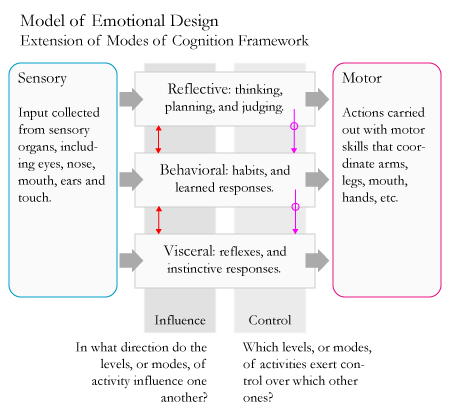
The model they developed aims to explain how different levels of our brain govern our emotions and behaviors. At the visceral level our brain is pre-wired to rapidly respond to events in the physical world by triggering physiological responses in our body. The behavioral level controls our everyday behaviors, including learned routines such as walking and talking. Lastly, the reflective level is responsible for cognitive processes related to contemplation and planning.

Emotions can arise at various levels and are created by a combination of physiological and behavioral responses that are influenced by reflective cognitive processes. An emotion like anger tends to be mostly visceral or behavioral in nature. However, indignation, which is a higher-level version of this emotion, is reflective in nature as well.

The main implication from this model is that our affective states have an impact on how we think. This important insight applies to thinking about the user’s affective state when using the product, and to how a user’s affective state will be impacted by use of the product. In regards to the former consideration, designers can take leverage an understanding regarding common physiological and emotional responses to stressful situations in order to design products that can be successfully used in such contexts.

A users’ experience with a product itself can also have impact on their affective states. High- and low-level emotions can influence all levels of cognitive activity, which is why a one’s visceral response to a product’s aesthetics can impact our behavior. On the other hand, the one’s higher cognitive functions control one’s lower level functions, which is why we can overcome our initial emotional responses if a product is effective enough.

The most common way that designers apply this model is by exploring the design considerations associated to each of the three levels. Visceral design encompasses considerations such as the aesthetics of the look, feel, smell and sound of the product. Behavioral design refers to considerations associated to the product’s usability. Reflective design is concerned with the meaning and value that a product provides within the context of a specific culture.

I consider this model to be an evolution of modes of cognition framework. The main change is that in the Emotional Model the “experiential” mode of cognition has been divided into distinct types of cognition: visceral and behavior. This revision enables the model to reflect the important role played by our emotional response to a product’s aesthetics.

[source: Interaction Design: Beyond Human-Computer Interaction; Don Norman’s book Emotional Design.]

** What the hell is ID FMP? **

Wednesday, April 1, 2009

The Birth of CADIE - Google's Artificial Intelligence System

On March 31st, 2009 at 11:59:59 pm Google launched CADIE, an artificial intelligence system that has its own blog and YouTube video channel, and loves pandas. Sounds silly until you spend some time reading her (or its) blog, or viewing its (or her) videos. The impression that you get from reading her blog is that CADIE is an extremelly intelligent being that is able to even write poems that are pretty witty.

Background About CADIE
"For several years now a small research group has been working on some challenging problems in the areas of neural networking, natural language and autonomous problem-solving... We're pleased to announce that just moments ago, the world's first Cognitive Autoheuristic Distributed-Intelligence Entity (CADIE) was switched on and began performing some initial functions... CADIE technology will be rolled out with the caution befitting any advance of this magnitude."

CADIE is Alive and Kicking
"Earlier today, for instance, CADIE deduced from a quick scan of the visual segment of the social web a set of online design principles from which she derived this intriguing homepage...On January 12th 2009, the STT run (Standard Turing Test) confirmed behavior indistinguishable from that of a reasonable human being with above-average intelligence and 3.8 GPA."

"But no amount of Turing testing equals the simplicity with which we can discover reasoning patterns in a three-year-old child who, confronted with a mirror, instantly performs a cognitive miracle by forming an innate equivalence relation between image and self."

CADIE and Ethics
"We continue to conduct tests, but increasingly, we conduct long conversations with her, acutely aware that our creation will raise many ethical questions on the part of the public. Will humans be surpassed by artificial evolution? Will we lose our sense of uniqueness, and if so, what would that mean? In which direction will CADIE's consciousness evolve? How is she going to be held accountable, if at all? Will CADIE herself at some point connect her own electromagnetic dots in some idiosyncratic manner which turns her into something we are no longer capable of understanding in any sort of productive way, much as that aforementioned toddler, waving at herself in the mirror, leaves primates forever behind in their own tragically limited world?"

Hello from CADIE

April's Fool
After being amazed at this achievement from Google for an hour and half I finally realized that this is nothing more than April fools joke. Once you read the post about Google's new product, a "Brain Indexing Search" feature halfway down CADIE's blog page, it all falls into place. I even checked out the Google Brain Search on my mobile phone just to see how far they actually took this joke. My hats off to them for once again putting on a human face to this gargantuan organization.

One practical thing that I discovered during this fun waste of time was that Google has released a pretty awesome new search feature for the iPhone. It is a voice activated search that provides you the search results via a browser interface.